Format, Dates & Attendance
The 75th Annual Conference on Applications of X-ray Analysis, more commonly known as the Denver X-ray Conference (DXC), was held 3-7 August 2026, marking the conference’s 75th anniversary. The week-long event returned to the Westin Chicago Lombard in Lombard, Illinois, USA.
X-ray and materials scientists convened to explore the latest developments in XRD and XRF techniques, applications, software, instrumentation, and products. With a dynamic mix of attendees and exhibitors, the conference welcomed more than 300 X-ray scientists, with over 25% traveling from outside the United States.
DXC Workshops
The technical program kicked off with 14 half-day tutorial workshops held on Monday and Tuesday of conference week. The workshops were organized into three categories—XRD, XRF, and Special Topics—and were designed to accommodate participants at both beginner and advanced levels. A total of 37 subject-matter experts were invited to serve as instructors, many of whom provided handouts available to attendees through a private website. Topics included:
- Capabilities at the Upgraded APS – Feature Beamlines and New Imaging Frontiers – Parts 1 & 2
- Introduction to XRD
- Basic XRF
- Environmental Analysis
- Sample Preparation for XRD
- Quantitative Analysis of XRF
- Biomedical Imaging – Parts 1 & 2
- Applied Cluster Analysis
- PDF Analysis: Principles, Instrumentation, and Applications
- Micro XRF & Trace Analysis
- 2D Detectors
- Benchtop Micro XRF Fundamentals
Plenary Session & DXC Awards
The Plenary Session, titled 75 Years of Brilliance: Honoring Our Past, Shaping DXC’s Future, was held Wednesday morning and marked the opening of the oral presentations that continued over the next three days. Andy Drews, Ford Motor Company, USA; Scott Misture, Alfred University, USA; Brian Toby, Argonne National Laboratory, USA; and Tom Watkins, Oak Ridge National Laboratory, USA, chaired the session, which began with an awards presentation.
The Birks Award
The Birks Award, presented biennially in recognition of outstanding contributions to the field of X-ray spectrometry, was awarded to Burkhard Beckhoff of Physikalisch-Technische Bundesanstalt, Germany. Dr. Beckhoff received the award for his research using both synchrotron radiation and calibrated instrumentation to develop reliable quantitative reference-free X-ray spectrometry. This analytical approach allows qualification of any kind of sample as calibration specimens and sets new benchmarks for materials analysis. Additionally, for his commitment to young researchers and to the international XRF community.
2026 Robert L. Snyder Student Grant Award
Twenty-five outstanding young scientists received the 2026 Robert L. Snyder Student Grant Award, the highest number of awardees in a single year. The awardees and the works they presented at the conference were:
Md Ashikuzzaman, University of Massachusetts Amherst, USA, XRD–XRF Integrated Evaluation of Glauconite Maturation and Elemental Evolution in Sands from New Jersey, USA
Meghan Brandt, Georgetown University, USA, The Effect of Dopants on Thymine Hydrate Dehydration
Karen Andrea Castaneda Marin, Illinois Institute of Technology, USA, In situ XAS Study of CuO-Based Catalysts during Pulsed Electrochemcial CO2 Reduction Reaction
Daniel Dodoo, University of Melbourne, Australia, High-Resolution 3D Synchrotron X-ray Micro-CT Resolves Talc–Quartz Phases and Morphologies in Mixed-Mineral Flotation Concentrates
Lindsey Foote, Georgetown University, USA, Polymorph Generation by Solid State Dehydration: 4-Hydroxycoumarin
Quinton Geller, University of Pennsylvania, USA, Quantifying Dislocation Density and Structure with X-ray Diffraction and Small Angle Scattering
Sebastian Hauser, Ulm University, Germany, Biomedical Investigation of Trace Element Analysis in Hard Biological Matter by Suspension-Assisted TXRF
Clayton Hearn, Baylor University, USA, In Situ XRD and DSC of Polymers for Additive Manufacturing
Beau Herrington, Keele University, United Kingdom, Using X-ray to Understand Prostate Tissue heterogeneity: A Multimodal Study & Collagen Microstructure in Prostate Cancer: An X-ray Scattering Study
Rawan Hirzalla, Hebrew University of Jerusalem, Israel, Impact of Organic Cation Architecture on Crystal Structure and Charge Carrier Separation in BiI3- and SbI3-Based Hybrids & Tuning Metal Halide Perovskite Dimensionality by Varying Iodo-Substituent Positions
Ahhyun Jeong, University of Chicago, USA, Colloidal Dispersions and Self-Assembly of Electrostatically Stabilized PbS Quantum Dots
Kyriacos Kyriacou, Keele University, United Kingdom, A Pre-processing Pipeline to Assess Tissue Heterogeneity in X-ray Scattering-Based Cancer Classification & Machine Learning Cancer ClassiEcation from X-ray Scattering of Prostate and Breast Tissue Across Clinical Grades
Benard Lawer, Illinois Institute of Technology, USA, Operando XAS Investigation of Pd-Decorated Ni(OH)2 and Ni0.9Co0.1(OH)2 as Bifunctional Electrocatalysts for Metal–Air Battery Applications
Shae London, Georgetown University, USA, Group I Urate Salts
Jessica Lyza, Alfred University, USA, Challenges in XPRD Analysis of Shear Structure Wadsley-Roth Phases for Battery Anodes & Challenges in Phase ID and Rietveld Analysis of Wadsley-Roth Shear Structures for Battery Anodes & Anisotropic Thermal Expansion and Structural Trends in Wadsley-Roth Crystallographic Shear-Block Oxides
Frithjof Mähler, Clausthal University of Technology, Germany, Using Kα XES to Determine Oxidation States of 3D-Elements in Dilute High Absorbing Samples
San Nguyen, Loyola University Chicago, USA,Heavy Metal X-ray Fluorescence Imaging of Plants Grown in Contaminated Soil
Chinonso Ogbodo, Illinois Institute of Technology, Chicago, USA, Toward Structure-Property Understanding of Biomass-Derived Carbon Electrodes Via Electrochemical and EXAFS Studies
Franziska Sand, Clausthal University of Technology, Germany, Influences on Picoliter-Derived Film Formation & Temperature-Related Changes in Picoliter Assisted Film-Like Morphology Formation
Roque Santiago, Alfred University, USA, Defect Engineering in Wadsley-Roth Anode Materials Using In-Situ XRD
Abu Sayed Mohammed Sayam, Purdue University, USA, Micro-XRF Imaging for Spatial Accumulation of Nanoparticles in Plant Leaves
Nina Scheffel, Bonn-Rhein-Sieg University, Germany, Combined Handheld-XRF and Raman Studies of Elephant and Mammoth Ivory
Hibiki Shirata, Meiji University, Japan, Mounting Method for Slurry-Type Samples for Quantitative Analysis by Powder X-ray Diffractometry
Bobby Tang, Toronto Metropolitan University, Canada, Quantitative Analysis of Bone Phantom Mineral Phase Composition Using Quantitative Powder X-ray Diffraction Spectrometry
Mandela Toku, Kwame Nkrumah University of Science and Technology, Ghana, Pristine Amorphous Silica Xerogel Inclusion in Limestone Calcined Clay Cement (LC3) Production
Plenary Session
Following the awards presentation, the plenary session continued with three captivating keynote talks delivered by Tim Fawcett (ICDD, USA), Ursula E. A. Fittschen (Clausthal University of Technology, Germany), and Chris Jacobsen (Northwestern University, USA).
Dr. Fawcett opened the session with his talk, 75 Years of Learning, Growth and Continuous Development in Materials Analysis with the Denver X-ray Conference. He was followed by Prof. Dr. Fittschen, who presented X-ray Based Microanalysis and Materials Characterization. The session concluded with Dr. Jacobsen’s presentation, X-rays Coming into Focus: Past and Future Journeys Towards Nanoimaging.
The session was well attended and provided a valuable look back at 75 years of DXC while offering insight into future advancements in X-ray science, technology, and materials analysis.
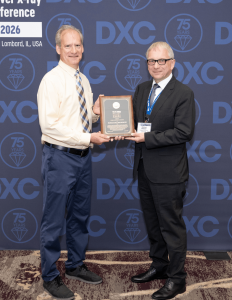
Scott Misture with Burkhard Beckhoff, the Birks Award Winner.
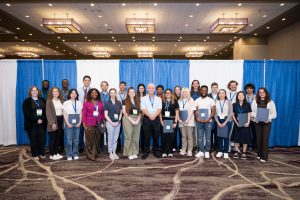
2026 Robert L. Snyder Student Grant Award Winners pictured with Tom Blanton.
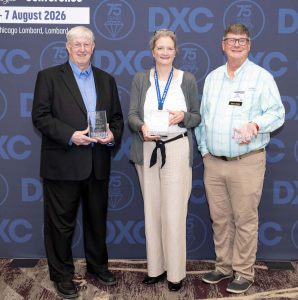
Plenary Speakers (L-R) – Tim Fawcett, Ursula E. A. Fittschen, and Chris Jacobsen.
Special Sessions
From Wednesday afternoon through Friday morning, 16 half-day oral sessions were held. Participants delivered more than 115 presentations, including 30 invited talks by experts in their fields. Topics included:
- New Developments in XRD & XRF Instrumentation
- State of the Art X-ray Approaches for Cultural Heritage
- SAXS & WAXS / Pair Distribution Function
- General XRF
- Agentic AI and Foundation Models for X-ray Science – Parts 1 & 2
- Synergy of Computational Materials and Process Engineer Modeling with Materials Characterization
- General XRD
- Early Career Researchers: Spotlight on the Next Generation
- Mining, Recycling, and Sustainable Materials
- Industrial Applications and Quantitative Analysis of XRF
- Stress and Texture Analysis
- Tomography and X-ray Microscopy
- Biomedical Imaging
- Industrial Applications of XRD
- Spatially-Resolved Benchtop Micro-XRF
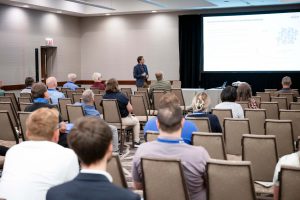
Nick Rodnesdy presenting during the New Developments Session.
Poster Sessions
Poster presentations took place on Monday and Tuesday evenings during the XRD and XRF poster sessions. Attendees could preview electronic versions of the posters in advance through the conference mobile app, PheedLoop. A panel of respected judges evaluated the submissions, with a strong field of entries competing for the Best Poster awards.
Ultimately, the following presenters were named winners:
XRD Best Poster Awards:
Benjamin Hulbert, NASA Glenn Research Center, USA, for their work: In situ Oxidation of the Nickel-based Superalloy Diamalloy 1005
Jessica Lyza, Alfred University, USA, for their work: Challenges in PXRD Analysis of Shear Structure Wadsley-Roth Phases for Battery Anodes
Kyriacos Kyriacou, Keele University, United Kingdom, for their work: A Pre-processing Pipeline to Assess Tissue Heterogeneity in X-ray Scattering-Based Cancer Classification
XRD Best Student Poster Award:
Mandela Toku, Kwame Nkrumah University of Science and Technology, Ghana, for their work: Pristine Amorphous Silica Xerogel Inclusion in Limestone Calcined Clay Cement (LC3) Production
XRF Best Poster Awards:
Javier Miranda, Universidad Nacional Autónoma de México, Mexico, for their work: X-ray Fluorescence Analysis of Ground Coffee from Commercial Pods
Chelsy Gonzalez, Illinois Institute of Technology, USA, for their work: Electrochemical Reduction of CO₂ Using CuO and CuO@ZnO Catalysts: Synthesis, Characterization, and Performance Evaluation
Michael Lara, Corning, USA, for their work: How Accurate Can µ-XRF Be? Quantification of a Binary SiO₂–TiO₂ Glass System
XRF Best Student Poster Award:
Sebastian Hauser, Ulm University, Germany, Biomedical Investigation of Trace Element Analysis in Hard Biological Matter by Suspension-assisted TXRF
We would like to thank Anton Paar and ICDD for both sponsoring additional awards during the XRD Poster Session.
Anton Paar Excellence in X-ray Analysis Poster Award:
Shae S. London, Georgetown University, USA for their work: Group I Urate Salts
ICDD® XRD Poster Award:
Shae S. London, Georgetown University, USA for their work: Group I Urate Salts
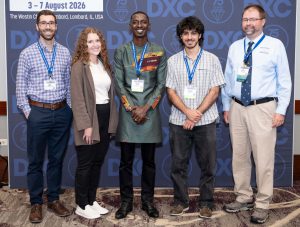
XRD Poster Session Award Winners (L-R) – Benjamin Hulbert, Jessica Lyza, Mandela Toku, Kyriacos Kyriacou, and Tom Watkins (Poster Judge).
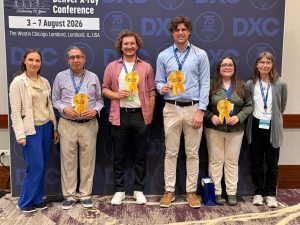
XRF Poster Session Award Winners (L-R) – Olga Antipova (Poster Judge), Javier Miranda, Sebastian Hauser, Michael Lara, Chelsy Gonzalez, and Martina Schmeling (Poster Judge).
We would like to thank two of our exhibitors for sponsoring additional Best Poster Awards during the XRF Poster Session, Amptek, Inc. and XOS.
Amptek Award for Best Student XRF Poster:
Steffen Witzleben, Bonn-Rhein-Sieg University, Germany, for their work: Synthesis and Characterization of Copper Nano Layers on Poly Electrolyte Membranes
XOS Innovation Award™:
1st Place: Hoon Seo, for their work: BORA: Boundary-Optimized ROI Acquisition from Hybrid AI Segmentation for Automated XRF Fine Scanning
Runner Up: Michael Lara, Corning, USA, for their work: How Accurate Can µ-XRF Be? Quantification of a Binary SiO₂–TiO₂ Glass System
75th Anniversary Celebration
On Wednesday evening, August 5, attendees gathered to celebrate the Denver X-ray Conference’s 75th anniversary. Conference Chair, Scott Misture, Alfred University, USA, welcomed attendees and shared a few words about the significance of this notable milestone. The evening provided an opportunity to reflect on DXC’s rich history and the many friendships and professional connections that have developed throughout its 75 years. A festive balloon arch welcomed guests, while photo collages highlighting the past 25 years and a timeline poster documenting the conference’s history over the past 75 years offered a glimpse into DXC’s remarkable journey. Attendees enjoyed dinner together as they celebrated this significant milestone and looked ahead to the future of the Denver X-ray Conference.

Many photo collages were on display during the anniversary celebration.
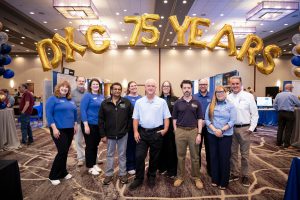
ICDD Staff under the balloon arch celebrating 75 years of DXC.
Exhibits & Sponsorships
The exhibit hall featured 27 companies showcasing a wide range of products and services for the X-ray community. For a complete list of exhibitors and their product descriptions, please refer to the 2026 Onsite Program, available at www.dxcicdd.com. The Denver X-ray Conference extends its sincere thanks to all exhibitors for their valuable support this year.
Many exhibitors also contributed as conference sponsors, including Amptek, Inc.; Anton Paar; Arcnano, Inc.; Bruker; ICDD; KETEK GmbH; Materials Data; Micro X-Ray; Petrick GmbH; Proto; Shanghai TiaYang Technology Co., Ltd.; Thermo Fisher Scientific; and XOS. Their generous contributions played a vital role in maintaining the high quality of the conference while helping to keep attendee costs affordable. We are truly grateful for their continued partnership and support.
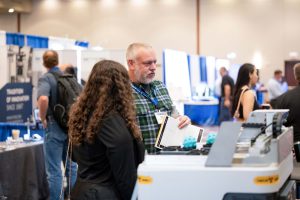
Attendees speaking with an exhibitor in the DXC exhibit hall.
Website & Proceedings
To view the complete DXC Program, please visit the ‘Past DXC’ page on the conference website, located under the ‘About DXC’ tab. The conference proceedings, Advances in X-ray Analysis, Volume 70, will be published in summer 2027. Free access to the full manuscripts published in Volumes 40 through 69 of Advances in X-ray Analysis is available through the ‘Resources’ tab on the ICDD website at www.icdd.com.
Thank You
The Conference Services team at ICDD extends its sincere appreciation to everyone who contributed their time, expertise, and enthusiasm to make the 75th Denver X-ray Conference a success. From the DXC Organizing Committee, Session Chairs, Workshop Instructors, and Invited and Contributed Speakers to our Exhibitors and Volunteers each played an important role in creating a successful and engaging conference.
We are especially grateful to all of the attendees who joined us for this milestone year. The continued success of DXC is made possible by the dedication, participation, and support of the entire X-ray community. Thank you to everyone who helped make the 75th anniversary of the Denver X-ray Conference a memorable celebration!
2027 Meeting
Save the Date!
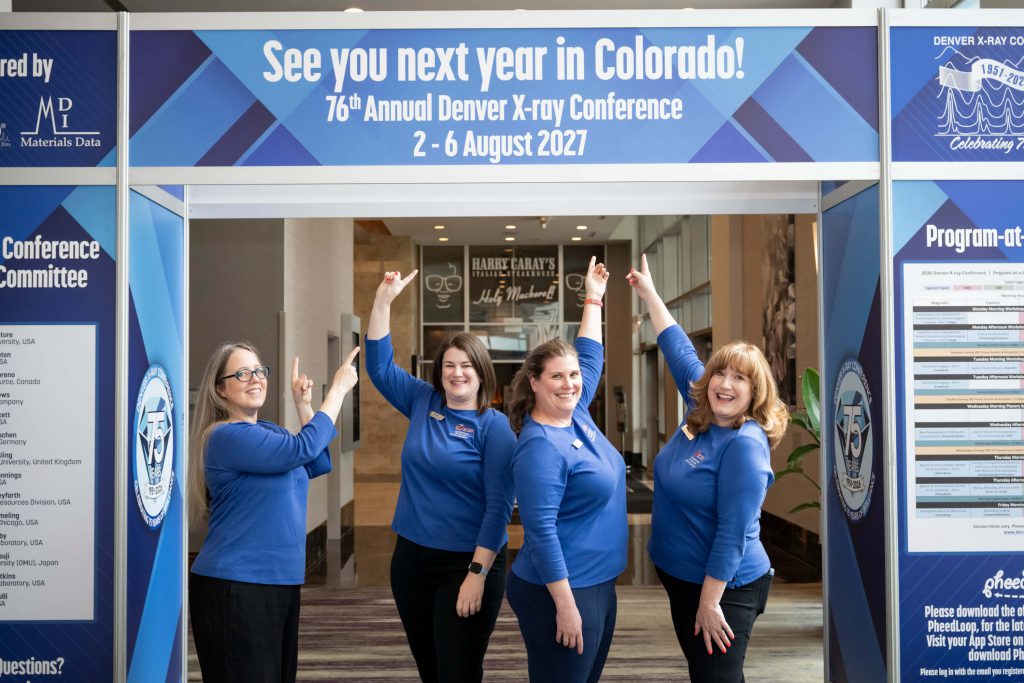
In 2027, the Denver X-ray Conference (DXC) will take place from 2-6 August at The Westin Westminster, Westminster, Colorado, USA. Start planning your pre- or post-conference mountain adventure now, and we look forward to seeing you in Colorado!